A Native American woman is among seven new saints canonised by Pope Benedict.
The canonisation coincided with a Vatican meeting of the world's
bishops on trying to revive Christianity in places where it has
struggled in recent years.
Kateri Tekakwitha, known as the "Lily of the Mohawks," was born in
1656 to a pagan Iroquois father and an Algonquin Christian mother.
Her parents and only brother died when she was four during a smallpox
epidemic that left her badly scarred and with impaired eyesight.
She went to live with her uncle, a Mohawk, and was baptised Catholic by Jesuit missionaries.
However she was ostracised and persecuted by other natives for her faith, and she died in what is now Canada when she was 24.
Native Americans in beaded and feathered headdresses and
leather-fringed tunics sang songs to St Kateri as the sun rose over St
Peter's Square ahead of this morning’s mass.
Another of the new
saints is Pedro Calungsod, a Filipino teenager who helped Jesuit priests
convert natives in Guam in the 17th century but was killed by villagers
opposed to the missionaries' efforts to baptise their children.
The other new saints are: Mother Marianne Cope, a 19th century
Franciscan nun who cared for lepers in Hawaii; Jacques Berthieu, a 19th
century French Jesuit who was killed by rebels in Madagascar, where he
had worked as a missionary.
Giovanni Battista Piamarta, an Italian who founded a religious order
in 1900 and established a Catholic printing and publishing house in his
native Brescia; Carmen Salles Y Barangueras, a Spanish nun who founded a
religious order to educate children in 1892.
Anna Schaeffer, a 19th century German lay woman who became a model
for the sick and suffering after she fell into a boiler and badly burned
her legs.
The wounds never healed, causing her constant pain.
+++++++++++++++++++++++++++++++++++++++++++++++++++
No responsibility or liability shall attach itself to either myself or to the blogspot ‘Mozlink’ for any or all of the articles/images placed here. The placing of an article does not necessarily imply that I agree or accept the contents of the article as being necessarily factual in theology, dogma or otherwise.
Mozlink
Fr. Damien, born 1840 in Tremeloo, Belgium. He joined the Congregation of the Sacred Hearts volunteering for the mission to the Hawaiian Islands. In 1873 he went to work as a priest in a leper colony on the island of Molokai. He died from leprosy in 1889 aged 49. The testimony of the life he lived among the lepers of Molokai led to an intensive study of Hansens disease, eventually leading to a cure. Pope John Paul II beatified Damien in 1995. He was named a saint on Oct 11th 2009.
Monday, October 22, 2012
Sunday, October 21, 2012
Sr Marianne Cope & Molokai
Mother Marianne,
far, right, led a group of six volunteers from the Sisters of St.
Francis to Hawaii to combat the health care crisis there. Their help was
so welcome the Hawaiian government awarded her a medal. Behind them
stands Prime Minister of the Hawaiian Kingdom.
In 1883 Mother Marianne Cope and five other sisters volunteered to travel to Hawaii to work with people afflicted with Hansen's disease. The disease, then known as leprosy, was so feared they were the only religious congregation to respond to a request for help. Mother Marianne wrote "I am not afraid of any disease." To this day none of the sisters has gotten sick.
The government resumed its policy of banishment for Hansen's disease patients in 1887. The island of Molokai became the location for Hawaii's banished citizens. Mother Marianne lived the rest of her days working with the afflicted in the remote location, separated from the rest of society.
There was a real
orphan crisis when the Hawaiian government started its policy of
banishment. Most institutions would not care for them nor would their
families since they were so afraid of the disease. The children would
roam the streets homeless. Mother Marianne Cope started several programs
to house the children near their parents.
While there was no cure for the residents of Molokai, the sisters tried to bring dignity to their lives. Before the sisters arrived, patients dressed in rags. The sisters gave the girls proper clothes and taught them embroidery, sewing and gardening. They also gave them music lessons.
Hansen's disease patients often lived a long life, but their daily needs were often neglected when they were banished. The sisters' arrival on Molokai brought the girls lessons in traditional education subjects and religious training, including giving the girls a proper first communion ceremony.
Prior to the sisters' arrival in Molokai, patients lived in ramshackle huts. Mother Marianne and the religious sisters were able to raise the money to build proper buildings for patients and give them beds instead of the straw mats they slept on.
Mother Marianne was beatified at the Vatican in 2005 after it declared a 14-year-old girl miraculously recovered from nearly total organ failure. The Franciscan sisters heard about her case and started praying to Mother Marianne for her recovery. The girl, Kate Mahoney, is still healthy today and is attending this weekend's ceremony.
The Sisters of
Saint Francis still minister to the sick and elderly in Hawaii. They run
a hospice program, provide home health service and run adult day care
programs. From left, Row 1: Sisters Ancilla Yim, Charlene Epil, Rose
Fatima Leite, Frances Cabrini Morishige, Laurenza Fernandez, Agnelle
Ching and William Marie Eleniki. From left, Row 2: Sisters Jovita
Agustin, Norise Kaiser, Agatha Perreira and Pat Schofield.
Mother Marianne Cope (in wheelchair) with other nuns and the women and girls of Bishop Home in Kalaupapa, Hawaii, shortly before her death in 1918.
+++++++++++++++++++++++++++++++++++++++++++++++++++
Disclaimer
No responsibility or liability shall attach itself to either myself or to the blogspot ‘Mozlink’ for any or all of the articles/images placed here. The placing of an article does not necessarily imply that I agree or accept the contents of the article as being necessarily factual in theology, dogma or otherwise.
Mozlink
In 1883 Mother Marianne Cope and five other sisters volunteered to travel to Hawaii to work with people afflicted with Hansen's disease. The disease, then known as leprosy, was so feared they were the only religious congregation to respond to a request for help. Mother Marianne wrote "I am not afraid of any disease." To this day none of the sisters has gotten sick.
The government resumed its policy of banishment for Hansen's disease patients in 1887. The island of Molokai became the location for Hawaii's banished citizens. Mother Marianne lived the rest of her days working with the afflicted in the remote location, separated from the rest of society.
There was a real
orphan crisis when the Hawaiian government started its policy of
banishment. Most institutions would not care for them nor would their
families since they were so afraid of the disease. The children would
roam the streets homeless. Mother Marianne Cope started several programs
to house the children near their parents. While there was no cure for the residents of Molokai, the sisters tried to bring dignity to their lives. Before the sisters arrived, patients dressed in rags. The sisters gave the girls proper clothes and taught them embroidery, sewing and gardening. They also gave them music lessons.
Hansen's disease patients often lived a long life, but their daily needs were often neglected when they were banished. The sisters' arrival on Molokai brought the girls lessons in traditional education subjects and religious training, including giving the girls a proper first communion ceremony.
Prior to the sisters' arrival in Molokai, patients lived in ramshackle huts. Mother Marianne and the religious sisters were able to raise the money to build proper buildings for patients and give them beds instead of the straw mats they slept on.
Mother Marianne was beatified at the Vatican in 2005 after it declared a 14-year-old girl miraculously recovered from nearly total organ failure. The Franciscan sisters heard about her case and started praying to Mother Marianne for her recovery. The girl, Kate Mahoney, is still healthy today and is attending this weekend's ceremony.
Mother Marianne Cope (in wheelchair) with other nuns and the women and girls of Bishop Home in Kalaupapa, Hawaii, shortly before her death in 1918.
+++++++++++++++++++++++++++++++++++++++++++++++++++
Disclaimer
No responsibility or liability shall attach itself to either myself or to the blogspot ‘Mozlink’ for any or all of the articles/images placed here. The placing of an article does not necessarily imply that I agree or accept the contents of the article as being necessarily factual in theology, dogma or otherwise.
Mozlink
Saturday, October 20, 2012
St. Marianne Cope, the woman who received a piano from Robert Louis Stev...
+++++++++++++++++++++++++++++++++++++++++++++++++++
Disclaimer
No responsibility or liability shall attach itself to either myself or to the blogspot ‘Mozlink’ for any or all of the articles/images placed here. The placing of an article does not necessarily imply that I agree or accept the contents of the article as being necessarily factual in theology, dogma or otherwise.
Mozlink
In Rome, for the canonization of Mother Marianne and Kateri Tekakwitha
SYRACUSE -- Hundreds of Central New Yorkers are in Rome for Sunday’s canonization of Mother Marianne Cope and Kateri Tekakwitha.
More than 350 people in the official pilgrimage of the Syracuse Diocese, led by Bishop Robert Cunningham, left Tuesday. Approximately 250 from the Diocese of Honolulu are also in Rome.
The pilgrims will spend time touring the Vatican, sacred sites and Assisi, the birthplace of St. Francis of Assisi, before attending the canonization of Mother Marianne, the former Syracuse Franciscan leader known for her 35-year ministry to leprosy patients in Hawaii.
Nine patients of the former leprosy settlement in Kalaupapa, where Mother Marianne ministered from 1883 until her death in 1918, will attend the canonization. The patients, who began their pilgrimage with a stop in Central New York last weekend, represent the 8,000 patients exiled by Hawaii over about 100 years.
The Upstate group will also celebrate the canonization of Kateri Tekakwitha, a 17th century Mohawk convert who lived in the area that is now Albany.
Kateri and Mother Marianne are among seven people Pope Benedict XVI will formally declare saints in an outdoor Mass in St. Peter’s Square.
Pilgrims celebrating Mother Marianne’s canonization include Sharon Smith, of Chittenango. The Vatican in December said it could find no medical explanation for Smith’s recovery in 2005 from severe pancreatitis and infection. That miracle was attributed to the intercession of Mother Marianne, and was a final step in the Vatican procedure that made her eligible for sainthood.
About 200 people connected with the Albany Diocese are in Rome, and the Archdiocese of Seattle has sent 67 people on its official pilgrimage. That group includes 12-year-old Jake Finkbonner and his family. The Vatican says the Ferndale, Wash., boy miraculously recovered from a flesh-eating illness in 2006 after prayers to Kateri Tekakwitha (pronounced Gah-deh-LEE Day-gah-GWEE-deh in Mohawk) on his behalf.
The Finkbonners are of Lummi descent; Kateri is the first Native American saint.
Hundreds of Mohawk Catholics from the North Country and Canada are also in Rome, as is a large group organized by the Kateri Tekakwitha Conference, a national organization based in Great Falls Montana. A small group of Syracusans is led by the Rev. Jim Carey, who was the first priest of the Syracuse Diocese assigned to minister to Native American Catholics in the late 1970s.
The U.S. Conference of Catholic Bishops estimated that up to 4,000 pilgrims from at least 15 diocese will be at the canonization.
On Saturday, the Hawaiian and Syracuse pilgrimages will attend a prayer service at the Church of San Gregorio Settimo, in Rome. The group will attend a Mass of Thanksgiving Monday at the Basilica Dei Santi Apostoli, in Rome.
A Mass of Thanksgiving for Saint Kateri is planned for Monday morning at St. Peter’s Basilica. The Shenandoah Trio will perform at the event.
The Post-Standard will cover the canonization.
Watch the canonization Mass live on EWTN or EWTN.com at 3:30 a.m. (Rome is six hours ahead of Syracuse) and 11 a.m. Sunday.
By Renée K. Gadoua, The Post-Standard
+++++++++++++++++++++++++++++++++++++++++++++++++++
Disclaimer
No responsibility or liability shall attach itself to either myself or to the blogspot ‘Mozlink’ for any or all of the articles/images placed here. The placing of an article does not necessarily imply that I agree or accept the contents of the article as being necessarily factual in theology, dogma or otherwise.
Mozlink
More than 350 people in the official pilgrimage of the Syracuse Diocese, led by Bishop Robert Cunningham, left Tuesday. Approximately 250 from the Diocese of Honolulu are also in Rome.
The pilgrims will spend time touring the Vatican, sacred sites and Assisi, the birthplace of St. Francis of Assisi, before attending the canonization of Mother Marianne, the former Syracuse Franciscan leader known for her 35-year ministry to leprosy patients in Hawaii.
Nine patients of the former leprosy settlement in Kalaupapa, where Mother Marianne ministered from 1883 until her death in 1918, will attend the canonization. The patients, who began their pilgrimage with a stop in Central New York last weekend, represent the 8,000 patients exiled by Hawaii over about 100 years.
The Upstate group will also celebrate the canonization of Kateri Tekakwitha, a 17th century Mohawk convert who lived in the area that is now Albany.
Kateri and Mother Marianne are among seven people Pope Benedict XVI will formally declare saints in an outdoor Mass in St. Peter’s Square.
Pilgrims celebrating Mother Marianne’s canonization include Sharon Smith, of Chittenango. The Vatican in December said it could find no medical explanation for Smith’s recovery in 2005 from severe pancreatitis and infection. That miracle was attributed to the intercession of Mother Marianne, and was a final step in the Vatican procedure that made her eligible for sainthood.
About 200 people connected with the Albany Diocese are in Rome, and the Archdiocese of Seattle has sent 67 people on its official pilgrimage. That group includes 12-year-old Jake Finkbonner and his family. The Vatican says the Ferndale, Wash., boy miraculously recovered from a flesh-eating illness in 2006 after prayers to Kateri Tekakwitha (pronounced Gah-deh-LEE Day-gah-GWEE-deh in Mohawk) on his behalf.
The Finkbonners are of Lummi descent; Kateri is the first Native American saint.
Hundreds of Mohawk Catholics from the North Country and Canada are also in Rome, as is a large group organized by the Kateri Tekakwitha Conference, a national organization based in Great Falls Montana. A small group of Syracusans is led by the Rev. Jim Carey, who was the first priest of the Syracuse Diocese assigned to minister to Native American Catholics in the late 1970s.
The U.S. Conference of Catholic Bishops estimated that up to 4,000 pilgrims from at least 15 diocese will be at the canonization.
On Saturday, the Hawaiian and Syracuse pilgrimages will attend a prayer service at the Church of San Gregorio Settimo, in Rome. The group will attend a Mass of Thanksgiving Monday at the Basilica Dei Santi Apostoli, in Rome.
A Mass of Thanksgiving for Saint Kateri is planned for Monday morning at St. Peter’s Basilica. The Shenandoah Trio will perform at the event.
The Post-Standard will cover the canonization.
Watch the canonization Mass live on EWTN or EWTN.com at 3:30 a.m. (Rome is six hours ahead of Syracuse) and 11 a.m. Sunday.
By Renée K. Gadoua, The Post-Standard
+++++++++++++++++++++++++++++++++++++++++++++++++++
Disclaimer
No responsibility or liability shall attach itself to either myself or to the blogspot ‘Mozlink’ for any or all of the articles/images placed here. The placing of an article does not necessarily imply that I agree or accept the contents of the article as being necessarily factual in theology, dogma or otherwise.
Mozlink
Sainthood ceremony for religious leader who cared for Hansen’s Disease exiles in Hawaii
Blessed Marianne Cope,
a member of the Roman Catholic Sisters of St. Francis who cared for
Hansen's Disease (leprosy) patients on Oahu and Molokai for three
decades beginning in the late 1880s, will be named as a saint during a
ceremony set for this Sunday (Oct. 21) at the Vatican in Rome.At the ceremony presided over by Pope Benedict XVI, the church will also canonize six other sainthood candidates, including Kateri Tekakwitha, a 17th century Mohawk Indian who spent most of her life in upstate New York.
About 250 Hawaii residents are in Rome for the ceremony, among them nine Hansen's Disease patients who reside at the former Molokai exile settlement at remote Kalaupapa Peninsula. Although cured, about a dozen people still live at the site, which is now part of Kakaupapa National Historical Park.
The Sisters of St. Francis of the Neumann Communities petitioned Pope Paul VI to open the cause for Mother Marianne’s canonization in 1974. Nine years later, an official registration took place, which then led to the titles of venerable, blessed and, now, saint. Canonization is conferred when the Vatican attributes two cases of miracles to a candidate for sainthood. In 2004 and 2011, Vatican officials ruled that cases of inexplicable medical recovery were due to the intercession of Mother Marianne, who died 96 years ago.
Barbara Koob (now officially "Cope") was born on Jan. 23 1838 in West Germany. The next year, her family moved to the United States and settled in Utica, N.Y. At age 24, Barbara entered the Sisters of St Francis in Syracuse, N.Y., where she received the religious habit, the name "Sister Marianne" and began working as a teacher and principal in several elementary schools in New York state.
Quickly recognized as a deft administrator, Cope was tapped to help
establish two general hospitals in New York state. Working alongside
doctors, she picked up medical knowledge on everything from sanitation
procedures to pharmacy skills, which she later put to use in Hawaii.In 1883, when an emissary from Hawaii sent letters seeking capable leaders to provide health care for patients with Hansen’s Disease, Mother Marianne was the only religious leader — out of 50 contacted — to respond positively. She reportedly wrote to the emissary: “I am not afraid of any disease, hence, it would be my greatest delight even to minister to the abandoned 'lepers.'"
During the decade preceding Mother Marianne's arrival in Hawaii with a group of sisters of the St. Francis order, thousands of Hansen's Disease patients throughout the Islands had been sent by government order to the Kalaupapa Peninsula. In 1873, Father Damien de Veuster moved to the island to live among the patients and minister to them. (Saint Damien was canonized in 2009.)

Mother Marianne first met Father Damien in January 1884, when he was in apparent good health. Two years later, in 1886, after he had been diagnosed with Hansen's Disease, Mother Marianne was reportedly the only religious leader to offer hospitality to the priest. (His illness made him an unwelcome visitor to church and government leaders in Honolulu.)
Several months before Father Damien's death in 1889, at age 49, Mother Marianne agreed to provide care for the patients at the Boys' Home at Kalawao that he had founded. Subsequently, Mother Marianne, along with two other nuns, ran the Bishop Home (for girls) and the Home for Boys at Kalawao.
Mother Marianne never returned to Syracuse, and neither she nor the nuns she worked with contracted Hansen’s Disease. Mother Marianne died on Aug. 9, 1918 in Hawaii and was buried on the grounds of Bishop Home.
During Cope's lifetime, the chronic, contagious disease then known as leprosy was shrouded in fear and mystery, despite having afflicted humankind for millennia. About a decade after Cope died drugs were developed that could effectively cure the bacterium-caused disease. Left untreated, the disease, which weakens the immune system, can open the door for potentially deadly infections, such as pneumonia.
For more information about Blessed Marianne Cope’s work in the Islands, click here.
by: Maureen O'Connell
+++++++++++++++++++++++++++++++++++++++++++++++++++
Disclaimer
No responsibility or liability shall attach itself to either myself or to the blogspot ‘Mozlink’ for any or all of the articles/images placed here. The placing of an article does not necessarily imply that I agree or accept the contents of the article as being necessarily factual in theology, dogma or otherwise.
Mozlink
Thursday, October 18, 2012
Synod on Evangelisation - Comments of Irish Bishops
H. Exc. Rev. Mons. Diarmuid MARTIN, Archbishop of Dublin (IRELAND)
The challenge of language is especially felt in those countries where English dominates, characterized by linguistic philosophies with known epistemological challenges. There is however a further challenge of the day-to-day language, not just of the media, but of a culture of the manipulation of language and the management of information where the meaning of words is changed and manipulated for commercial, ideological or political motives.
The concern I wish to particularly address is the challenge that this manipulation of language represents for young people in their search for the message of Jesus Christ. Young people live in a culture of relativism and indeed banalization of the truth often without even being aware of it. It is a culture which they did not create. They may not know any other culture, yet they must find Christ in the midst of this culture while they have little familiarity with the language of faith.
I am not thinking here of the large groups of young people who have found strength and support in events such as World Youth Day, but of the many young men and women who, at what is a complex and difficult time in their lives, in their search for meaning find themselves very much alone among their classmates and fellow students and indeed may experience hostility and incomprehension as they try to find or maintain their faith in Jesus Christ.
Where are we present among the large student population, especially for those whose basic Christian education may well have been all but superficial in either family or school?
The challenge of the New Evangelization must be marked by a robust confrontation of ideas, not in terms of ideological aggression, but in helping young people in the discernment of ideas.
The culture of individualism can be counteracted by the creation of a variety of new ecclesial communities, not just those of the ecclesial movements, but around our parishes, which will be the building blocks of the Eucharistic communities of the future.
H. Exc. Rev. Mons. Kieran O'REILLY, S.M.A., Bishop of Killaloe (IRELAND)
The momentum created by the recently held International Eucharistic Congress in Ireland has been further enhanced by the publication of a New National Directory for Catechesis in Ireland titled: Share the Good News. This document from the Bishops Conference is a blueprint for the Church throughout Ireland.
Share the Good News points to the complete statement of faith, the Catechism of the Catholic Church, searching out sure ways of making the treasures to be found in the Catechism more readily available to people in Ireland today. It is also a call to action with the aim of seeking to help members of the Church speak confidently of the Gospel message which each generation of believers must assimilate anew. It is a programme with a ten-year horizon: the first two years are given over to a period of implementation and making the Directory known, followed by full implementation throughout the dioceses of Ireland.
Hand in hand with Share the Good News must go a more profound knowledge and understanding of the Good News as preached and lived in the New Testament. Quoting Verbum Domini #: 51 ... “the church is a community that hears and proclaims the word of God. The Church draws life not from herself but from the Gospel, and from the Gospel she discovers ever anew the direction for her journey” This calls for a fuller and significant biblical apostolate
The Irish Church has lived, and continues to live, the recent crises in a dramatic way. At the same time, we are faced with the same effects of secularisation as many other countries, particularly in Europe. As a result, the church must now speak with a voice which is hopeful yet humble, confident yet compassionate, with a claim to authority that must be more evidently rooted in the Gospel and the love of Christ. This is the context in which the new evangelization will take place.
I hope this Synod will send words of encouragement to all the agents of the New Evangelization, in particular, to the many women who play a significant role in the life of our Church, expressing our gratitude to them for their generous activity in spreading the Gospel in the various settings of daily life where they are centrally present - at work, in schools, in the family and in healthcare. These, and other committed members of our faith communities, expect and await a message of hope and encouragement from this Synod, as we invite them to engage with evangelical courage the new evangelization in the different Aeropagii of our time.
+++++++++++++++++++++++++++++++++++++++++++++++++++
Disclaimer
No responsibility or liability shall attach itself to either myself or to the blogspot ‘Mozlink’ for any or all of the articles/images placed here. The placing of an article does not necessarily imply that I agree or accept the contents of the article as being necessarily factual in theology, dogma or otherwise.
Mozlink
The challenge of language is especially felt in those countries where English dominates, characterized by linguistic philosophies with known epistemological challenges. There is however a further challenge of the day-to-day language, not just of the media, but of a culture of the manipulation of language and the management of information where the meaning of words is changed and manipulated for commercial, ideological or political motives.
The concern I wish to particularly address is the challenge that this manipulation of language represents for young people in their search for the message of Jesus Christ. Young people live in a culture of relativism and indeed banalization of the truth often without even being aware of it. It is a culture which they did not create. They may not know any other culture, yet they must find Christ in the midst of this culture while they have little familiarity with the language of faith.
I am not thinking here of the large groups of young people who have found strength and support in events such as World Youth Day, but of the many young men and women who, at what is a complex and difficult time in their lives, in their search for meaning find themselves very much alone among their classmates and fellow students and indeed may experience hostility and incomprehension as they try to find or maintain their faith in Jesus Christ.
Where are we present among the large student population, especially for those whose basic Christian education may well have been all but superficial in either family or school?
The challenge of the New Evangelization must be marked by a robust confrontation of ideas, not in terms of ideological aggression, but in helping young people in the discernment of ideas.
The culture of individualism can be counteracted by the creation of a variety of new ecclesial communities, not just those of the ecclesial movements, but around our parishes, which will be the building blocks of the Eucharistic communities of the future.
H. Exc. Rev. Mons. Kieran O'REILLY, S.M.A., Bishop of Killaloe (IRELAND)
The momentum created by the recently held International Eucharistic Congress in Ireland has been further enhanced by the publication of a New National Directory for Catechesis in Ireland titled: Share the Good News. This document from the Bishops Conference is a blueprint for the Church throughout Ireland.
Share the Good News points to the complete statement of faith, the Catechism of the Catholic Church, searching out sure ways of making the treasures to be found in the Catechism more readily available to people in Ireland today. It is also a call to action with the aim of seeking to help members of the Church speak confidently of the Gospel message which each generation of believers must assimilate anew. It is a programme with a ten-year horizon: the first two years are given over to a period of implementation and making the Directory known, followed by full implementation throughout the dioceses of Ireland.
Hand in hand with Share the Good News must go a more profound knowledge and understanding of the Good News as preached and lived in the New Testament. Quoting Verbum Domini #: 51 ... “the church is a community that hears and proclaims the word of God. The Church draws life not from herself but from the Gospel, and from the Gospel she discovers ever anew the direction for her journey” This calls for a fuller and significant biblical apostolate
The Irish Church has lived, and continues to live, the recent crises in a dramatic way. At the same time, we are faced with the same effects of secularisation as many other countries, particularly in Europe. As a result, the church must now speak with a voice which is hopeful yet humble, confident yet compassionate, with a claim to authority that must be more evidently rooted in the Gospel and the love of Christ. This is the context in which the new evangelization will take place.
I hope this Synod will send words of encouragement to all the agents of the New Evangelization, in particular, to the many women who play a significant role in the life of our Church, expressing our gratitude to them for their generous activity in spreading the Gospel in the various settings of daily life where they are centrally present - at work, in schools, in the family and in healthcare. These, and other committed members of our faith communities, expect and await a message of hope and encouragement from this Synod, as we invite them to engage with evangelical courage the new evangelization in the different Aeropagii of our time.
+++++++++++++++++++++++++++++++++++++++++++++++++++
Disclaimer
No responsibility or liability shall attach itself to either myself or to the blogspot ‘Mozlink’ for any or all of the articles/images placed here. The placing of an article does not necessarily imply that I agree or accept the contents of the article as being necessarily factual in theology, dogma or otherwise.
Mozlink
Supporters arrive in the Vatican for canonization of Mother Marianne Cope
![]() |
| DAN NAKASO / DNAKASO@STARADVERTISER.COM |
Honolulu Bishop Larry Silva spoke to Hansen's disease patients from
Kalaupapa just before the pope drove within a few feet of the patients
after the event. The group got a front-row seat for today's papal
audience with Pope Benedict XVI.
ROME -- Pilgrims from Syracuse are now walking the streets of Rome in anticipation of Sunday’s Canonization of Mother Marianne Cope.
Bishop Robert Cunningham,
the leader of the Diocese of Syracuse, touched down at da Vinci Airport
just outside of Rome early Wednesday morning. By mid-morning he was
joined by the rest of more than 200 who were part of his pilgrimage to
the Vatican and Assisi.
The
Sisters of St. Francis and their group of 100 arrived the day before.
They were off first thing Wednesday morning to a Papal Audience in St.
Peter’s Square. Their sacred time will take them away from Rome on
Thursday as they head to the hometown of St. Francis the founder of
their order.
St. Francis lived in Assisi in the early 13th
century. He took a vow of poverty and service that his followers have
continued ever since. While in Assisi the sisters will visit a
Leprosaria where people with Hansen’s disease still live today. It is a
home similar to the one in Molokai where Mother Marianne ministered in the late 19th and early 20th centuries in the Hawaiian Islands.
In
addition to the groups from Syracuse there is a contingent that came
8,000 miles from Hawaii to celebrate the Canonization of Marianne Cope.
There are also hundreds of Mohawks, other Native Americans and others supporting Kateri Tekawitha as the first Native American saint in the Catholic Church.
by Matt Mulcahy CNY Central News
Our
Matt Mulcahy is traveling with the pilgrims from Syracuse in Rome and
the surrounding areas. He will continue to share their story on NBC 3,
CBS 5, CW 6, CNYCentral.com, Facebook and Twitter right through the Canonization Sunday morning.
+++++++++++++++++++++++++++++++++++++++++++++++++++
Disclaimer
No responsibility or liability shall attach itself to either myself or to the blogspot ‘Mozlink’ for any or all of the articles/images placed here. The placing of an article does not necessarily imply that I agree or accept the contents of the article as being necessarily factual in theology, dogma or otherwise.
Mozlink
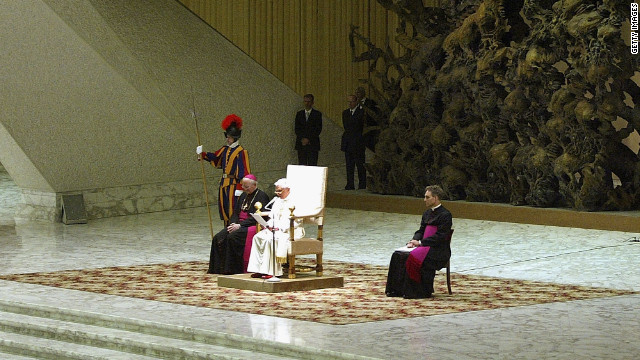
Before a Nun Is Sainted, Honoring Her Upstate Past
UTICA, N.Y. — But for a wooden sign at its edge, the vacant field
resembled any other in a neighborhood of factories and worn-out
buildings here, not far from the Erie Canal: a few trees scattered
across thick green grass, a patch of shaggy weeds growing beside a
boarded-up garage at its rear.
Disclaimer
No responsibility or liability shall attach itself to either myself or to the blogspot ‘Mozlink’ for any or all of the articles/images placed here. The placing of an article does not necessarily imply that I agree or accept the contents of the article as being necessarily factual in theology, dogma or otherwise.
Mozlink
![]() |
Nathaniel Brooks for The New York Times |
(Photo Right) Ivy Kahilihiwa, part of a group from Hawaii
celebrating the canonization of Mother Marianne, greeting Sister Rosanne
LaManche at St. Anthony Convent in Syracuse last weekend.
![]() |
Nathaniel Brooks for The New York Times
|
And yet, on Sunday, three tour buses bearing more than 100 Hawaiian
pilgrims arrived. Ignoring a steady stream of rain, they climbed across
the buckled sidewalk to pray for a woman who once lived on this land,
whose favorite hymn, “O Makalapua,” they know by heart and whose face they wore on pins, medallions and specially made Hawaiian shirts: Mother Marianne Cope.
Mother Marianne will be one of seven Roman Catholic saints — including another New Yorker, Kateri Tekakwitha
— canonized by Pope Benedict XVI on Sunday. The pilgrims had stopped en
route to Rome to celebrate the canonization of a woman beloved in
Hawaii and known as “Mother of the Outcasts” for her work among the
sick. “She was just an ordinary person, like us,” said Charlotte Recarte, 67, a
retiree from Oahu. “Inside all of us, we can be saints. We just have to
do the work. That’s what Mother Marianne did.”
Born Barbara Koob in what is now Germany, Mother Marianne moved with her
family to Utica in 1839, when she was a year old. Her faith was formed
at St. Joseph’s church and parish school, which she attended until
eighth grade. When her father grew ill, she left school to work for in
the city’s factories to help support her younger siblings. In 1862, when
they were old enough to care for themselves, she entered the Sisters of
St. Francis in Syracuse.
In 1883, she answered a call to help thousands of Hawaiians who were ill with a mysterious and disfiguring disease known as leprosy and who were being taken from their families and exiled to a remote peninsula on Molokai called Kalaupapa. Would the nun take charge of the hospitals and lead a ministry among these patients? “I am not afraid of any disease,” she wrote, agreeing to what would
become a more-than-30-year mission serving those banished to the
towering sea cliffs of Kalaupapa. She also paved the way for others in
her order to continue her work, connecting communities in Hawaii and New
York.
Eight thousand people with leprosy, now known as Hansen’s disease, lived
on Kalaupapa from 1866 until the isolation laws were lifted in 1969.
Among the 17 still alive, 9 traveled to New York to visit the life that
the nun had left behind. “I wanted to come to learn about what she was before Kalaupapa,” Ivy Kahilihiwa said.
Ms. Kahilihiwa arrived on Kalaupapa in 1958, after a small mark on her
back signaled her illness. By that time, medicine was available to help
ease her pain, but she saw in the older patients the disfigurement that
was widespread before treatment became available. “It made me so grateful for Mother Marianne,” Ms.
Kahilihiwa, 76, said. “Not anybody could go there and do that work to
help so many who suffered.” As they crisscrossed central New York visiting her home, her convent and
her first parish, the pilgrims — patients, parishioners and clergy
members from across Hawaii, including Larry Silva, the bishop of Honolulu — saw pieces of Mother Marianne’s youth.
At St. Joseph and St. Patrick Church,
opposite the site of the original wooden building where Mother Marianne
first prayed, parishioners welcomed the Hawaiians for a prayer service. “Shalom.” “Aloha.”
“We are so joyful you are here.” Incense filled the air of the towering Italianate-style church. Hymns
were accompanied by ukulele and pu‘ili, a Hawaiian bamboo rattle.
Stephen Prokop, the superintendent of Kalaupapa National Historical Park, performed a reading in his forest green uniform, a kukui nut lei strung around his neck. “Mother Marianne is a major, major figure in the history of Kalaupapa,”
he said afterward, adding, “I wanted to learn more about Mother
Marianne’s life.”
The group traveled between Utica and nearby Syracuse throughout the day. At St. Elizabeth Medical Center
in Utica, one of two hospitals in central New York that Mother Marianne
helped establish, a group of Hawaiian nuns dashed into a parking lot,
hugging two nuns who had been waiting to glimpse members of their order,
whom they had not seen in years. And during the final stop of the day,
at St. Anthony Convent of the Sisters of St. Francis of the Neumann Communities
in Syracuse, the last patients of Kalaupapa met with now-retired nuns
who had continued the work of Mother Marianne, ministering on the
peninsula before the isolation ended.
At the convent where Mother Marianne began her religious life and where
her remains lie, the former patients and nuns clasped hands and steadied
one another, recalling the beauty of the landscape and the nicknames of
those on the island: “tip toe,” “tom boy,” “the fishing nun.” Sister Rosanne LaManche, 92, smiled while listening to the shared
memories of long ago. She recalled her arrival on the island in 1949. “Driving in along the peninsula, I saw that along one road there were
graves, graves, graves,” she said, shaking her head. “Mother Marianne
should’ve been canonized the day she died.”
+++++++++++++++++++++++++++++++++++++++++++++++++++
Disclaimer
No responsibility or liability shall attach itself to either myself or to the blogspot ‘Mozlink’ for any or all of the articles/images placed here. The placing of an article does not necessarily imply that I agree or accept the contents of the article as being necessarily factual in theology, dogma or otherwise.
Mozlink
Two New Saints for America
![]() |
| Most Rev. John Vlazny Archbishop of Portland |
Clearly, if that happens, I won’t be alive to witness it. But I hope to be alive on Sunday, Oct. 21, when two Americans will be canonized by Pope Benedict XVI in Rome. Altogether seven people will be canonized including a Filipino and some European founders of religious orders. The two Americans are Blessed Marianne Cope, a member of the Sisters of St. Francis of Syracuse, N.Y., who spent many years caring for the lepers on the island of Molokai, Hawaii, and Blessed Kateri Tekakiwitha, a 17th-century Mohawk girl who converted to Catholicism and died young. Folks in the state of New York have to be proud because these two women were New Yorkers.
They say that Blessed Marianne was a born leader. She worked many years at St. Joseph’s Hospital in Syracuse. But eventually she volunteered to go to Hawaii to take care of lepers. There she met St. Damien de Veuster on the island of Molokai. She brought education and happiness to the leper colony and she was greatly revered. Unlike St. Damien, she died of natural causes on Aug. 9, 1918, and was buried in Hawaii.
There is great interest in Blessed Kateri here in the Pacific Northwest because she will be our first Native American saint. She was known as the “Lily of the Mohawks.” She was an orphan at the age of 4 and was raised by her uncle, a chief in a Mohawk village. Jesuit priests who visited the village caught her attention and eventually she became a Catholic at age 20. Many of her relatives were displeased and her open practice of the faith, including Sunday Mass and lots of prayer and fasting, placed her life in jeopardy. She eventually left her village and escaped to Montreal and a community where she was able to live her faith freely. She took a vow of virginity and died in 1680 at the early age of 24.
A final miracle is needed for the canonization of any person after his or her beatification. The miracle attributed to Blessed Kateri’s intercession involved the full recovery of a young boy in Seattle. Last year in December Pope Benedict XVI signed the decree, which recognized the miracle as authentic. This cleared the way for Blessed Kateri’s canonization.
Because Blessed Kateri is so widely venerated among our Native American people, I would like to offer some more thoughts about this important canonization for our church here in the United States. It has taken a long time for her holiness to be recognized officially by the church. But her holiness was acknowledged throughout her life and she was honored almost immediately after her death by all those around her. She has also been described as the “Mystic of the Wilderness,” a contemplative whose life was immersed in the presence of God which she found there in the wilderness of those days so long ago.
To be honest, we have to admit that many tribes of the Native American people suffered great travesties of justice during the early colonization of this great land. Many misconceptions and tall tales spread about them quickly, which were nurtured by indifference or prejudice on the part of the newcomers to America. We all know that these Native Americans were commonly referred to as Indians until rather recently, an erroneous term attributed to the fact that Christopher Columbus believed that he had come to the “Indies.” The Native Americans were also called Redskins, even though their coloring was quite varied in appearance, from very fair to dark brown.
The original ancestors of Kateri’s people were of Mongolian or some other Asiatic stock. They came here from Siberia some 20,000 years ago, maybe even earlier. They were nomadic or semi-nomadic in their lifestyle, human beings involved in the last stages of what is called the Great Ice Age. They came without any notion of claiming a new continent for their own. They were primitive people whose far-ranging journeys crossed the United States, with many of them reaching South America and the Andes.
Kateri’s people lived in the northeastern part of America. The early inhabitants were described as “the Forest People of North America.” In reading some biographies of Blessed Kateri, one develops a great admiration for the Jesuit missionaries who made great sacrifices to bring the good news of Jesus Christ to the new world. French Jesuits, Sulpicians, Franciscans, the Sacred Heart Fathers and many other priests from the European Catholic world served unselfishly to make this new world Christian. They overcame prejudices and they even gave their lives as a witness to their faith. This, of course, made a deep impression on many people, including contemporaries of Kateri. Even before she was baptized, Kateri had become a woman of prayer, much in the tradition of the native people. The Jesuit missionary, Father De Lamberville, who catechized Kateri, did not rush her to the waters of Baptism. She was eventually baptized on Easter Sunday, 1676.
Kateri’s resistance to marriage and her embrace of virginity confounded many of the villagers, especially the women. She wanted to give herself exclusively to Christ and, as a woman of deep prayer, God’s grace flowered in her soul. She even suffered the indignity of a false accusation regarding her virginity. In her innocence she trusted that God would provide her with his protection. Not long thereafter the angel of death approached her. She prepared to meet her God, strengthened by the sacramental gift of Viaticum, with serenity and great trust. She died on April 17, 1680. At the monument in her memory at Auriesville, New York, she is described as “the most beautiful flower that ever bloomed for the Indians.”
Many organizations were active in the cause for her canonization and in the spread of her message of peaceful surrender to the will of God. This weekend we thank God for the gift of the canonization of Blessed Kateri and Blessed Marianne. I continue to pray that one day one of you will be similarly recognized for your holiness of life.
+++++++++++++++++++++++++++++++++++++++++++++++++++
Disclaimer
No responsibility or liability shall attach itself to either myself or to the blogspot ‘Mozlink’ for any or all of the articles/images placed here. The placing of an article does not necessarily imply that I agree or accept the contents of the article as being necessarily factual in theology, dogma or otherwise.
Mozlink
Hawaiian worshipers heading to Italy for canonization of 2 Mohawk Valley women
![]() |
| ANGELICA A. MORRISON / Observer- Photo |
The Rev. John E. Mikalajunas packs his bags, Monday Oct. 15, 2012, at the Holy Trinity Church Rectory in preparation for a trip to Rome for the canonization of Blessed Marianne Cope, which is taking place Oct. 21. This is Mikalajunas' 14th time visiting Rome. "I'm excited every time," he said. "It's always adventurous, and the fact that she's from our area makes it even more exciting."
UTICA — Betty Frank traveled more than 4,200 miles from New York to Rome,
Italy, seven years ago to attend the beatification of Mother Marianne
Cope.
After that, she made a promise to herself: If she was healthy, and if
she felt up to the trip, she would attend Blessed Marianne’s
canonization, officially designating her as a saint.“I trust in the Lord and I made that promise,” said Frank, 85, of Utica.
Frank’s prayers were answered. She is making the same pilgrimage to the Vatican this week with more than 200 parishioners, priests and others associated with the Roman Catholic Diocese of Syracuse.
The group, led by Bishop Robert Cunningham, left today and will stay in Italy for a week to attend Sunday’s canonizations of Blessed Marianne and six others.
Blessed Marianne isn’t the only one representing the Mohawk Valley. Blessed Kateri Tekakwitha lived in what is today Fonda. She will be canonized as the first Native American saint. Frank said she remembers learning about Marianne and Kateri in school. When she was young, she prayed to the two women. “The double excitement I have …” said Frank, pausing to choose the right words to express her joy. “The pleasure I have to live in a time when the two saints that I was really hoping some day would be canonized both together; it’s the greatest blessing.” The Rev. Richard Dellos of St. Joseph & St. Patrick Church in Utica said he is especially excited about the upcoming canonization. After all, Marianne was a parishioner of the church in the 19th century. She was born Barbara Koob in Germany but immigrated to Utica when she was 2. She also was student at the parish school. “It is a special time,” Dellos said. “She only lived around the block, she went to school here. We feel very near and dear to her.”
And Kateri was just a stone’s throw away in Fonda, though a little less than 200 years before Marianne’s time. The site where she lived has become the home of the National Shrine of St. Kateri Tekakwitha. It’s said she was baptized with the same water that fills a well on the grounds.
Dellos and other priests from the Syracuse diocese will help celebrate Mass Sunday at the Vatican. The Rev. John Mikalajunas, of the Holy Trinity Church in Utica, expects thousands of people to flood the Vatican for the canonization. He estimated that about 25 people from the Utica area would be making the trip.
Before the main event, the group from the Syracuse diocese is planning
several sightseeing trips around Italy, including one to Assisi, the
town of St. Francis, the namesake saint of the order of nuns to which
Marianne belonged. “We’re obviously preparing with good walking shoes,” Mikalajunas said, laughing.
Rose Marie Roberts, a St. Joseph & St. Patrick parishioner from Whitesboro, is getting ready for her first trip across the pond for the canonization. But this is no regular vacation for her. The coordinator for the church’s Perpetual Adoration chapel said she has a special connection to Marianne. Several years ago, her mother was diagnosed with myelodysplasia, a bone marrow disorder that slows the production of red blood cells. She required blood transfusions once every three months. Then every two months. Then once a month. It got to the point where Roberts’ mother needed the transfusions two to three times a week.
Roberts heard Marianne’s remains were to be on display at her church. She brought her mother to pray, maybe for the last time. “I was praying for a peaceful death for my mother,’ said Roberts, 54. “And honestly, she was probably praying for the same thing.” After the Mass, the transfusions stopped. It was the unexplained miracle that brought about Roberts’ adoration of Marianne, she said. She said she hopes Sunday’s canonization will have a far-reaching effect on the Mohawk Valley. The event might make God and the church more tangible to youth of the area. “Getting a saint in our midst like that is a wonderful benefit we need to take advantage of,” Roberts said. “She was a common person in our community, and (youths) can relate to that.”
+++++++++++++++++++++++++++++++++++++++++++++++++++ Rose Marie Roberts, a St. Joseph & St. Patrick parishioner from Whitesboro, is getting ready for her first trip across the pond for the canonization. But this is no regular vacation for her. The coordinator for the church’s Perpetual Adoration chapel said she has a special connection to Marianne. Several years ago, her mother was diagnosed with myelodysplasia, a bone marrow disorder that slows the production of red blood cells. She required blood transfusions once every three months. Then every two months. Then once a month. It got to the point where Roberts’ mother needed the transfusions two to three times a week.
Roberts heard Marianne’s remains were to be on display at her church. She brought her mother to pray, maybe for the last time. “I was praying for a peaceful death for my mother,’ said Roberts, 54. “And honestly, she was probably praying for the same thing.” After the Mass, the transfusions stopped. It was the unexplained miracle that brought about Roberts’ adoration of Marianne, she said. She said she hopes Sunday’s canonization will have a far-reaching effect on the Mohawk Valley. The event might make God and the church more tangible to youth of the area. “Getting a saint in our midst like that is a wonderful benefit we need to take advantage of,” Roberts said. “She was a common person in our community, and (youths) can relate to that.”
By SARA TRACEY
Disclaimer
No responsibility or liability shall attach itself to either myself or to the blogspot ‘Mozlink’ for any or all of the articles/images placed here. The placing of an article does not necessarily imply that I agree or accept the contents of the article as being necessarily factual in theology, dogma or otherwise.
Mozlink
Sunday, October 14, 2012
Leprosy Survivors Look To Mother Marianne Cope's Sainthood
This 1883 photo provided by the Sisters of St. Francis of the Neumann
Communities shows Mother Marianne Cope, a nun who dedicated her life to
caring for exiled leprosy patients on Kalaupapa in Hawaii. The Vatican's
Congregation for the Causes of Saints on Tuesday, Dec. 6, 2011,
recommended to the pope that Cope be canonized, confirming previous
rulings that a second miracle was due to her intercession. (AP
photo/Sisters of St. Francis of the Neumann Communities)
KALAUPAPA, Hawaii (RNS) At 81, Barbara Marks is among the last 17 leprosy patients Hawaii banished to the remote peninsula of Kalaupapa. Over more than 100 years, beginning in 1866, more than 8,000 were separated from their families and taken to this distant point on Molokai, where Mother Marianne Cope ministered to the settlement.
With the Oct. 21 canonization of Cope at the Vatican, and their numbers dwindling, the remaining patients are eager to make sure their stories are recorded and their home preserved. "I've heard people say it would be a nice resort," Marks said. "I don't want them to do that to Kalaupapa. I don't want it to change. It's our home."
Patients such as Marks describe doctors taking "snips" of their skin to test for leprosy, being poked and prodded and stared at as if they were "a monkey show." They recall burying spouses, having babies taken away and spending family visits with a chain-link fence separating them from their relatives. Still, many spoke with affection for the place they call home and their connection to the Hawaiian history that created two Roman Catholic saints: Father Damien and now Mother Marianne. "I had a lot of sadness, but my life was not all bad," Marks said.
Their stories date to 1865, when Hawaii's King Kamehameha V implemented a policy of forced exile by approving the Act to Prevent the Spread of Leprosy. Kalaupapa was chosen as the site of what became the world's first leper colony because of its location. Cliffs as high as 2,000 feet cut the settlement off from the rest of Molokai, which is approximately in the center of Hawaii's eight islands.
Today, the small village is a quiet, pristine retreat seemingly untouched by modern life. Black lava boulders hug the shores, and the waves are a constant, rhythmic backdrop. Visitors require permission; access is a rocky journey down a 1,700-foot mountainside by foot or mule, or by nine-seat plane.
The first exiles -- 12 patients, one stowaway child and several kokuas (family members acting as helpers or caregivers) -- were taken to Kalaupapa by boat on Jan. 6, 1866. By 1873, when Father Damien began working on Kalaupapa, about 600 patients had been shipped there. In 1890, two years after Cope and several other Franciscan sisters from Syracuse, N.Y., began their ministry, the patient population reached a high of about 1,200.
In the early years, survival was rare. Ten of the first 12 patients died within two years. By the 1940s, medication had been developed that prevented the transmission of leprosy, now called Hansen's disease. Few patients were forced to Kalaupapa after 1949, and Hawaii formally lifted the quarantine in 1969. Patients were free to leave. But many chose to stay: Kalaupapa had become home, and other patients were family.
In 2005, when the remains of Cope were exhumed as part of the Roman Catholic Church's canonization process, 37 patients remained on the settlement's rolls; 28 still called Kalaupapa their permanent home.
Nine leprosy patients sent to Kalaupapa will take a pilgrimage to Rome for Cope's canonization later this month.
Sister Francis Therese Souza, 69, has worked as a nurse on Kalaupapa since 1989, when 99 patients lived there. She is one of about 61 Franciscan sisters who have ministered there since 1888. Three sisters live there now, Souza and two who serve as volunteers with the National Park Service. "It's a little harder each time one of them dies," Souza said. Every day, she remembers her connection to the Franciscan sisters who traveled 5,000 miles into the unknown to dispense medicine and compassion. She's conscious she may be the last Franciscan to do so. "I might be the one to close the door for Mother Marianne," she said.
Sister Theresa Chow, one of two Franciscans living at the settlement's St. Elizabeth Convent, learned when she moved to Kalaupapa that she is related to a patient. Honolulu Bishop Larry Silva learned about 15 years ago that his great-grandfather and a great aunt died at Kalaupapa. To Clarence "Boogie" Kahilihwa, who went there in 1959, "it was like a prison." Two sisters and a brother had been sent to Kalaupapa ahead of him, he said. "We were mostly programmed. They made me feel dirty.'Go here, don't go there, don't touch that.' You could not get close. They were strict. Maybe some were scared. Maybe they were ignorant. A couple of times I said to myself,'Why did I become a patient? Maybe I did something bad and was punished.'"
After being treated at a hospital, he chose to move to Kalaupapa. "Old people said,'Why you shut your life away from society?'" he recalled. "For me it was better. I had a brother and sisters there." His wife, Ivy, recalls an aunt leaving home and never returning. When she developed spots on her face and hands, "I did not know what it was. They told me I had to be separated. No one told me what it was."
For Gloria Marks, who came in 1960, Kalaupapa meant marriage -- in 1962, to fellow patient Richard Marks -- and a family. They had two sons, who were raised by her parents because health officials worried the children would contract leprosy. Barbara Marks also had a child, Edward Kaito Damien Marks, who also was raised by her mother. "I didn't want to hold him," she said matter-of-factly. "I didn't want him to end up like me. There was nothing I could do. I had to be strong."
In 2008, Hawaii acknowledged such situations when the state legislature passed a resolution apologizing to former leprosy patients for the policy of exile. The Hawaii Department of Health is committed to caring for patients, providing housing, medical care, meals and modest stipends.
In 1976, Kalaupapa was designated a National Historic Landmark and, in 1980, Kalaupapa National Historical Park was created. As long as patients remain, the state of Hawaii and the National Park Service will continue to provide services and protect their dignity and privacy, said Stephen Prokop, Kalaupapa park superintendent. The park service is working on a long-term plan that will include preservation, education and interpretation of the site. There will be no recreational use, and no sea access is planned.
"It's not a traditional place to come and swim and surf," Prokop said. "It's a sacred place and we want to respect that."
(Renee K. Gadoua writes for The Post-Standard in Syracuse, N.Y.)
+++++++++++++++++++++++++++++++++++++++++++++++++++
No responsibility or liability shall attach itself to either myself or to the blogspot ‘Mozlink’ for any or all of the articles/images placed here. The placing of an article does not necessarily imply that I agree or accept the contents of the article as being necessarily factual in theology, dogma or otherwise.
Mozlink
KALAUPAPA, Hawaii (RNS) At 81, Barbara Marks is among the last 17 leprosy patients Hawaii banished to the remote peninsula of Kalaupapa. Over more than 100 years, beginning in 1866, more than 8,000 were separated from their families and taken to this distant point on Molokai, where Mother Marianne Cope ministered to the settlement.
With the Oct. 21 canonization of Cope at the Vatican, and their numbers dwindling, the remaining patients are eager to make sure their stories are recorded and their home preserved. "I've heard people say it would be a nice resort," Marks said. "I don't want them to do that to Kalaupapa. I don't want it to change. It's our home."
Patients such as Marks describe doctors taking "snips" of their skin to test for leprosy, being poked and prodded and stared at as if they were "a monkey show." They recall burying spouses, having babies taken away and spending family visits with a chain-link fence separating them from their relatives. Still, many spoke with affection for the place they call home and their connection to the Hawaiian history that created two Roman Catholic saints: Father Damien and now Mother Marianne. "I had a lot of sadness, but my life was not all bad," Marks said.
Their stories date to 1865, when Hawaii's King Kamehameha V implemented a policy of forced exile by approving the Act to Prevent the Spread of Leprosy. Kalaupapa was chosen as the site of what became the world's first leper colony because of its location. Cliffs as high as 2,000 feet cut the settlement off from the rest of Molokai, which is approximately in the center of Hawaii's eight islands.
Today, the small village is a quiet, pristine retreat seemingly untouched by modern life. Black lava boulders hug the shores, and the waves are a constant, rhythmic backdrop. Visitors require permission; access is a rocky journey down a 1,700-foot mountainside by foot or mule, or by nine-seat plane.
The first exiles -- 12 patients, one stowaway child and several kokuas (family members acting as helpers or caregivers) -- were taken to Kalaupapa by boat on Jan. 6, 1866. By 1873, when Father Damien began working on Kalaupapa, about 600 patients had been shipped there. In 1890, two years after Cope and several other Franciscan sisters from Syracuse, N.Y., began their ministry, the patient population reached a high of about 1,200.
In the early years, survival was rare. Ten of the first 12 patients died within two years. By the 1940s, medication had been developed that prevented the transmission of leprosy, now called Hansen's disease. Few patients were forced to Kalaupapa after 1949, and Hawaii formally lifted the quarantine in 1969. Patients were free to leave. But many chose to stay: Kalaupapa had become home, and other patients were family.
In 2005, when the remains of Cope were exhumed as part of the Roman Catholic Church's canonization process, 37 patients remained on the settlement's rolls; 28 still called Kalaupapa their permanent home.
Nine leprosy patients sent to Kalaupapa will take a pilgrimage to Rome for Cope's canonization later this month.
Sister Francis Therese Souza, 69, has worked as a nurse on Kalaupapa since 1989, when 99 patients lived there. She is one of about 61 Franciscan sisters who have ministered there since 1888. Three sisters live there now, Souza and two who serve as volunteers with the National Park Service. "It's a little harder each time one of them dies," Souza said. Every day, she remembers her connection to the Franciscan sisters who traveled 5,000 miles into the unknown to dispense medicine and compassion. She's conscious she may be the last Franciscan to do so. "I might be the one to close the door for Mother Marianne," she said.
Sister Theresa Chow, one of two Franciscans living at the settlement's St. Elizabeth Convent, learned when she moved to Kalaupapa that she is related to a patient. Honolulu Bishop Larry Silva learned about 15 years ago that his great-grandfather and a great aunt died at Kalaupapa. To Clarence "Boogie" Kahilihwa, who went there in 1959, "it was like a prison." Two sisters and a brother had been sent to Kalaupapa ahead of him, he said. "We were mostly programmed. They made me feel dirty.'Go here, don't go there, don't touch that.' You could not get close. They were strict. Maybe some were scared. Maybe they were ignorant. A couple of times I said to myself,'Why did I become a patient? Maybe I did something bad and was punished.'"
After being treated at a hospital, he chose to move to Kalaupapa. "Old people said,'Why you shut your life away from society?'" he recalled. "For me it was better. I had a brother and sisters there." His wife, Ivy, recalls an aunt leaving home and never returning. When she developed spots on her face and hands, "I did not know what it was. They told me I had to be separated. No one told me what it was."
For Gloria Marks, who came in 1960, Kalaupapa meant marriage -- in 1962, to fellow patient Richard Marks -- and a family. They had two sons, who were raised by her parents because health officials worried the children would contract leprosy. Barbara Marks also had a child, Edward Kaito Damien Marks, who also was raised by her mother. "I didn't want to hold him," she said matter-of-factly. "I didn't want him to end up like me. There was nothing I could do. I had to be strong."
In 2008, Hawaii acknowledged such situations when the state legislature passed a resolution apologizing to former leprosy patients for the policy of exile. The Hawaii Department of Health is committed to caring for patients, providing housing, medical care, meals and modest stipends.
In 1976, Kalaupapa was designated a National Historic Landmark and, in 1980, Kalaupapa National Historical Park was created. As long as patients remain, the state of Hawaii and the National Park Service will continue to provide services and protect their dignity and privacy, said Stephen Prokop, Kalaupapa park superintendent. The park service is working on a long-term plan that will include preservation, education and interpretation of the site. There will be no recreational use, and no sea access is planned.
"It's not a traditional place to come and swim and surf," Prokop said. "It's a sacred place and we want to respect that."
(Renee K. Gadoua writes for The Post-Standard in Syracuse, N.Y.)
+++++++++++++++++++++++++++++++++++++++++++++++++++
No responsibility or liability shall attach itself to either myself or to the blogspot ‘Mozlink’ for any or all of the articles/images placed here. The placing of an article does not necessarily imply that I agree or accept the contents of the article as being necessarily factual in theology, dogma or otherwise.
Mozlink
Thursday, October 11, 2012
"A Servant of the Lepers": Brother Joseph of Molokai
By Pat McNamara, October 08, 2012

Joseph's journey to Molokai was full of twists and turns. Born Ira Barnes Dutton in Vermont on April 27, 1843, he grew up in a thoroughly Protestant setting. By age 18, he was teaching Sunday school in Wisconsin and working in a bookstore, when the Civil War broke out. It was an exciting time, he recalled: "streets lined with cheering crowds, bands playing, flags flying." He enlisted in September 1861, and for the next four years he served with the 13th Wisconsin Infantry Regiment.
Although the regiment saw little fighting during the war, Ira showed leadership and administrative skills, reaching the rank of Captain. As quartermaster, one fellow officer remembered him as having "a rare gift for business." He liked army life, and he considered it as a career, but military downsizing meant few commissions. Discharged in 1866, he spent the next two decades in a variety of jobs.
He married a woman he met during the war. It proved to be tragic, "one of those things I have tried to forget" (he never mentioned her name). Friends warned of her reputation for infidelity, but Ira had hoped to change her. A shopaholic who left him broke, she soon ran off with another man. Dutton seemed to hope she might return; he didn't file divorce papers until 1881.
After the war, he worked in cemeteries. He then oversaw a distillery in Alabama before working in Memphis on the railroads. In 1875, he joined the War Department settling claims against the government.
Successful in every field, he was nevertheless a functioning alcoholic. In the day, he was a solid citizen, but he spent his evenings with "John Barleycorn," although "I never injured anyone but myself."
Increasingly ashamed of this double life, in 1876 he vowed never to drink again, remaining sober until his death. He also experienced a spiritual transformation. While he fell away from religion during the war, he became interested in Catholicism through the influence of Catholic friends. After studying the catechism for a month, he was received into the Catholic Church on April 27, 1883, his 40th birthday. He changed his name to Joseph, his favorite saint, retired from the government, and began a "new life."
Wanting to do penance for his "wild years" and "sinful capers," Joseph set out for Our Lady of Gethsemani Monastery, Kentucky. Founded in 1848, he had earlier visited the place in connection with his government work. Now he resolved to do "penance for the rest of my years." After twenty months, he concluded that his life should be one of penitent action rather than contemplation. Still, he wrote, it was "what I needed at the time." (He remained lifelong friends with the Trappist monks, remembering them in his will.)
It was only after reading about Father Damien that he found his "real vocation":
The work attracted me wonderfully.
After weighing it for a while I became convinced that it would suit my
wants—for labor, for a penitential life, and for seclusion as well as
complete separation from scenes of all past experiences. It seems a mere
accident that I ever heard of this place, and it might never have
happened again.
Dr.
Pat McNamara is a Professor of Church History at St. Joseph's Seminary,
Dunwoodie. He blogs about American Catholic History at McNamara's Blog.McNamara's column, "In Ages Past," is published every Tuesday on the Catholic portal. Subscribe via email or RSS.
+++++++++++++++++++++++++++++++++++++++++++++++++++
Disclaimer
No responsibility or liability shall attach itself to either myself or to the blogspot ‘Mozlink’ for any or all of the articles/images placed here. The placing of an article does not necessarily imply that I agree or accept the contents of the article as being necessarily factual in theology, dogma or otherwise.
Mozlink
Tuesday, October 9, 2012
Inside the world's 1st leper colony where the patients do not want to leave
'We were stranded, but I loved it': Inside the world's first leper colony where the patients don't want to leave.
Positioned on the clifftops of Hawaii with stunning views and the calming sounds of the crashing waves, Kalaupapa would be the perfect location for any spa retreat.
But for the last 146 years, the small village has been used as a colony for leprosy patients, many of whom were torn from their families and banished to the idyllic peninsula for quarantine.
Kalaupapa, the world's first leper colony, had a population of 1,200 patients at its height and has treated more than 8,000 sufferers since it opened in 1866.
See full article, photos and video on Daily Mail website at www.dailymail.co.uk/news/article-2214602/Inside-worlds-leper-colony-patients-dont-want-leave.html
+++++++++++++++++++++++++++++++++++++++++++++++++++
Disclaimer
No responsibility or liability shall attach itself to either myself or to the blogspot ‘Mozlink’ for any or all of the articles/images placed here. The placing of an article does not necessarily imply that I agree or accept the contents of the article as being necessarily factual in theology, dogma or otherwise.
Mozlink
- Kalaupapa, Hawaii, has treated 8,000 sufferers since it opened in 1866
- Sufferers were banished there after Hawaiian king brought in quarantine law
- The 17 current leprosy patients are keen to stay at the place they call home
Positioned on the clifftops of Hawaii with stunning views and the calming sounds of the crashing waves, Kalaupapa would be the perfect location for any spa retreat.
But for the last 146 years, the small village has been used as a colony for leprosy patients, many of whom were torn from their families and banished to the idyllic peninsula for quarantine.
Kalaupapa, the world's first leper colony, had a population of 1,200 patients at its height and has treated more than 8,000 sufferers since it opened in 1866.
+++++++++++++++++++++++++++++++++++++++++++++++++++
Disclaimer
No responsibility or liability shall attach itself to either myself or to the blogspot ‘Mozlink’ for any or all of the articles/images placed here. The placing of an article does not necessarily imply that I agree or accept the contents of the article as being necessarily factual in theology, dogma or otherwise.
Mozlink
Tuesday, October 2, 2012
![]() |
| Vickie Nesbit, The Oregonian |
Molokai's remote north shore was where Hawaiians with leprosy were cast off, initially with little provisions or medical care. More than 8,000 were sent to Kalaupapa, the fields of unmarked graves attesting to the thousands who died there. But the settlement is also a tribute to the thousands who lived for decades as exiles, shunned by society while suffering from the disfiguring ailment, also known as Hansen's disease.
It's into this world of tidy white cottages, churches, stores and beaches that the Kalaupapa mules travel, transporting visitors to a place that has changed little over time. Think of an undeveloped, lush and sleepy Hawaii -- with a history of heartbreak looming over the scene, just like the green vertical Pali cliffs that separate the peninsula from "topside" Molokai.
But first you have to get there, no easy feat when the destination is a place where people were dropped by boat with the notion they wouldn't be leaving by foot. You can hike the trail, 3 miles one way with 26 switchbacks; fly in from the Molokai or Honolulu airports; or sign up for the Kalaupapa Guided Mule Tour. All visitors must have a permit to visit the settlement, now a National Historical Park. Once in Kalaupapa, a guide from Father Damien Tours leads the 3- to 4-hour visit, respecting the privacy of the roughly 15 former patients who still live there.
Four-footed route
Visiting Molokai
You may think you've been to Hawaii, but then there's Molokai.
Across the Pailolo Channel are Maui's
bustling high-rise towers, while Molokai prides itself on having no
skyline at all. For tourists, the 260-square-mile island has one
full-service hotel, a handful of other lodging options and several small
restaurants, making it a throwback to Hawaii of another era.
And while that's an appealing draw, it's
not necessarily a sleepy paradise. Molokai has historically had
Hawaii's highest unemployment rate, a situation that wasn't helped four
years ago when the island's major landowner closed its sprawling tourist
properties over a battle with island residents who opposed plans to
build more luxury housing. Left in its wake is the eerie town of
Maunaloa, built to look like a quaint plantation village but now boarded
up. Anti-development signs with faded paint dot the roadsides, and the
island was briefly in the news last year when residents protested a
small cruise ship that was scheduled to dock.
Controversy aside, Molokai has its
rustic charms, from a twisty, scenic drive to the Halawa Valley to the
purple sweet potato-flavored ice cream at Dave's in Kaunakakai, the main
town. It's not Honolulu, nor would you want it to be.
While the island isn't known for its
sandy beaches, it does have tourist destinations such as Purdy's Natural
Macadamia Nut Farm, the Molokai Museum and Cultural Center and, of
course, the trip to Kalaupapa.
One bonus of visiting Molokai is the
flight there and back in a small, nine-seat Cessna from Mokulele
airlines. You'll see what the captain sees: the stunning, sheer cliffs
of Molokai's north shore, inaccessible except by boat or air. It's a
beautiful way to say aloha to an island that invites tourists on its own
terms, a handful at a time.
Sproat, a former rodeo star with the bowed legs to prove it, has been running mules on Molokai from the ramshackle shed at the start of the trail since 1973. The outfit takes care of the permits for the trip (limited to 100 per day and to ages 16 and above) and packs a lunch for the riders. After an hour and a half on the mules, riders come out on the beach, dismount and wobble over to an old school bus driven by a Father Damien Tour guide.
Talking story
The lilting voice of guide Norman Soares, a part-time Kalaupapa resident and auto mechanic (a useful skill to keep the ancient buses running), takes the little group through the settlement, first stopping at the store owned by Gloria Marks. She and her husband, Richard Marks, a former patient, started Father Damien Tours in 1966 to introduce visitors to the community and dispel myths about the disease. Richard Marks, who died in 2008, was considered an international ambassador for those suffering from Hansen's disease.
As Soares explained, Hansen's is a chronic illness caused by a bacterium that damages the nerves, skin, respiratory tract and eyes. Patients don't die of Hansen's itself, but from secondary conditions brought on by the disease. When King Kamehameha V made the decision in 1865 to exile those suspected of being infected, little was understood about the disease, which carried a stigma from biblical times. Families were torn apart when members -- even a child -- were taken to live on Molokai. If a baby was born at Kalaupapa to parents with Hansen's, the infant was shipped off the island for adoption.
Early on there was little help for those on Molokai, but that changed with the 1873 arrival of Joseph de Veuster, a 33-year-old Belgian priest. Known as Father Damien, he gained worldwide acclaim for his work to improve the living conditions of those afflicted. After 11 years Damien contracted leprosy, dying in 1889. We know now that 95 percent of the world's population has a natural immunity to Hansen's disease; Damien's misfortune was that he was in the other 5 percent. But his years on Molokai left a lasting legacy, and in 2009 the Roman Catholic Church made him a saint.
Another saint on the way
Following in Father Damien's footsteps was Mother Marianne Cope, less known than Damien but critical to the work on Molokai. Formerly Barbara Koob of Utica, New York, she arrived in Kalaupapa in 1888, months before Damien's death, already having established herself as a progressive hospital administrator in New York. Those skills served her well in Kalaupapa, Soares said. Father Damien was a visionary, he explained, but Mother Marianne had the practical skills to put plans into action. She was instrumental in moving most of the patients from the rainy Kalawao side of the peninsula to the drier west side, where most of the Kalaupapa settlement is now based, and expanded the community significantly with help from her Franciscan sisters.
Mother Marianne died of natural causes in 1918. On Oct. 21, she too will be canonized by the Roman Catholic Church, the second saint to rise from Molokai's shores.
Winding down
At the height of the settlement, more than 1,000 people lived on the peninsula. Eventually there was a theater, Lions Club, historical society, musical groups and churches. Entertainers and writers of the era visited Kalaupapa, including John Wayne, Shirley Temple, Robert Louis Stevenson and Ernie Pyle.
Kalaupapa Mule Tour
The tour: Mondays-Saturdays, $199; includes mule ride, entry permits, Father Damien guide and lunch. For reservations: 800-567-7550, muleride.com
Getting to the island: Mokulele,
Island Air, Pacific Wings and Makani Kai are the inter-island airlines
serving Molokai. Makani Kai also flies directly to Kalaupapa from
Honolulu and Molokai airports. Another option is a daily ferry that runs
between Maui and Molokai: 888-307-6524 , molokaiferry.com
More information: Kalaupapa National Historical Park, nps.gov/kala
Soares' tour takes visitors to several other sites in the settlement, noting that some places, such as the post office, are off limits for the sake of former patients' privacy. A ride on the bus to Kalawao ends at Father Damien's landmark church, St. Philomena, with a grave marker (his right hand is buried there) and a look at the picturesque bay where Hansen's patients were cast off in the early years. It's a lovely, hushed place for a picnic lunch before the bus rumbles back to Kalaupapa and the trail topside.
The mules' trip to the barn is brisk, although the riders are mostly quiet and subdued. That is, until Makani the mule lets loose a long-winded and sonorous blast of flatulence. Buzzy Sproat's earlier cryptic comment about her name becomes clear: Makani means wind in Hawaiian, but she didn't earn it because of her speed.
Soon other mules join in and the group has a good laugh, just another unexpected adventure on the trail to Kalaupapa.
By Vickie Nesbit, The Oregonian
+++++++++++++++++++++++++++++++++++++++++++++++++++
Disclaimer
No responsibility or liability shall attach itself to either myself or to the blogspot ‘Mozlink’ for any or all of the articles/images placed here. The placing of an article does not necessarily imply that I agree or accept the contents of the article as being necessarily factual in theology, dogma or otherwise.
Mozlink
Tuesday, September 25, 2012
Fr. Damien
Above is an illustration of the young Damien of Molokai.
The Presbyterian minister, Dr. Hyde of Honolulu, in 1889 wrote the
following attack about Fr. Damien of Molokai to his friend, Reverend
H.B. Gage and said the following things about Fr. Damien:“Honolulu. August 2, 1889.
Rev. H.B. Gage: “Dear Brother—In answer to your inquiries about Fr. Damien, I can only reply that we who knew the man are surprised at the extravagant newspaper laudations, as if he was a most saintly philanthropist. The simple truth is, he was a coarse, dirty man, headstrong and bigoted.
”He was not sent to Molokai, but went there without orders; did not stay at the leper settlement (before he became one himself), but circulated freely over the whole island (less than half the island is devoted to the lepers), and he came often to Honolulu. He had no hand in the reforms and improvements inaugurated, which were the work of our Board of Health, as occasion required and means were provided.
”He was not a pure man in his relations with women, and the leprosy of which he died should be attributed to his vices and carelessness. Others have done much for the lepers, our own ministers, the government physicians, and so forth, but never with the Catholic idea of meriting eternal life.—Yours, etc.”
The famous writer, Robert Louis Stevenson, had just visited the leper colony at Molokai and heard first hand accounts of Fr. Damien’s work there. When he read such a slanderous defamation of Fr. Damien from a minister of his own denomination, he became enraged and begins a famous response called Fr. Damien: An Open Letter to the Reverend Dr. Hyde of Honolulu:
”You (Dr. Hyde) have done me (Stevenson) several courtesies, for which I was prepared to be grateful. But there are duties which come before gratitude, and offences which justly divide friends, far more acquaintances. Your letter to the Rev. H.B. Gage is a document, which, in my sight, if you had filled me with bread when I was starving, if you had sat up to nurse my father when he lay a-dying, would yet absolve me from the bonds of gratitude.”
Stevenson is saying that the sin of slander against the priest is so awful, that there is nothing that should prevent him from exposing how down low and dirty the calumny is. He is saying that if there is anytime to break rank with your friends and even forget their courtesies to you, it is when they have slandered an innocent person. Setting the record straight may not be nice, and you may lose followers for it, but all the niceness of your friends can never be an excuse for covering up or ignoring their calumnies against someone.
Disclaimer
No responsibility or liability shall attach itself to either myself or to the blogspot ‘Mozlink’ for any or all of the articles/images placed here. The placing of an article does not necessarily imply that I agree or accept the contents of the article as being necessarily factual in theology, dogma or otherwise.
Mozlink
Tuesday, September 18, 2012
SSCC Leadership for the next six years
![]() |
| Fr. Javier Alvarez Ossorio & Sr. Emperatriz Arrobo |
This General Chapter, the highest authority within the Congregation,
is seeking concrete orientations for the mission of this religious
family, starting from the needs of the world and Church, being
especially attentive to those who are living at the margins and at the
edge of society.
Biographic data of the Superior General of the Brothers
Fr. Javier was born in Seville in 1962, the second of three brothers. He studied at Colegio San José SS.CC. He made his temporary profession in the Congregation of the Sacred Hearts in 1982. In 1987, he was ordained to the priesthood by the archbishop of Seville, Cardinal Amigo in Sacred Hearts Parish. He worked in various ministries of the Congregation with the most disadvantaged before doing his licentiate in Sacred Scripture at the Catholic Institute of Paris.
After these studies he was assigned to the Democratic Republic of Congo in en 1993, where he finished his licentiate in Philosophy at the University of Kinshasa. In 2001 he was elected as the first Provincial Superior of Africa and was reelected in 2004, a job he held until being elected as Superior General in 2006.
The newly elected is a member of the Executive Committee of the USG (Union of Superiors General). Over the past six years he has written a monthly letter to the Congregation, inspired by what he sees in the real life of the Congregation and by personal reflection on what the texts which inspire the religious life of the Sacred Hearts might possibly mean for today. This letter has been an impetus in the renewal, commitment and spirituality of the SS.CC. religious. In addition, he is a regular columnist for the 21st religious magazine in Spain.
Biographic data of the Superior General of the Brothers
Fr. Javier was born in Seville in 1962, the second of three brothers. He studied at Colegio San José SS.CC. He made his temporary profession in the Congregation of the Sacred Hearts in 1982. In 1987, he was ordained to the priesthood by the archbishop of Seville, Cardinal Amigo in Sacred Hearts Parish. He worked in various ministries of the Congregation with the most disadvantaged before doing his licentiate in Sacred Scripture at the Catholic Institute of Paris.
After these studies he was assigned to the Democratic Republic of Congo in en 1993, where he finished his licentiate in Philosophy at the University of Kinshasa. In 2001 he was elected as the first Provincial Superior of Africa and was reelected in 2004, a job he held until being elected as Superior General in 2006.
The newly elected is a member of the Executive Committee of the USG (Union of Superiors General). Over the past six years he has written a monthly letter to the Congregation, inspired by what he sees in the real life of the Congregation and by personal reflection on what the texts which inspire the religious life of the Sacred Hearts might possibly mean for today. This letter has been an impetus in the renewal, commitment and spirituality of the SS.CC. religious. In addition, he is a regular columnist for the 21st religious magazine in Spain.
Biographic data of the Superior General of the Sisters
Emperatriz Arrobo Lima ss.cc. was born in 1959 in Loja (Ecuador). She has been the Provincial of Ecuador and the Coordinator of the Latin American Conference of the religious women of the Sacred Hearts.
During her religious life she has served as director of schools, formator of religious women, as well as in tasks of governance and coordination. She is a psychologist by profession. She has become the first Latin American Superior General in the history of the Congregation.
The sisters highlight her honesty, simplicity, organization, respect, clarity and closeness.
PS: It was the Superior General of the Congregation of the Sacred Hearts of the time, who responded to a request of the Holy See to send missionaries to the Pacific Islands, which led to Fr. Damien ministering on Molokai.
+++++++++++++++++++++++++++++++++++++++++++++++++++
Disclaimer
No responsibility or liability shall attach itself to either myself or to the blogspot ‘Mozlink’ for any or all of the articles/images placed here. The placing of an article does not necessarily imply that I agree or accept the contents of the article as being necessarily factual in theology, dogma or otherwise.
Mozlink
Subscribe to:
Posts (Atom)